

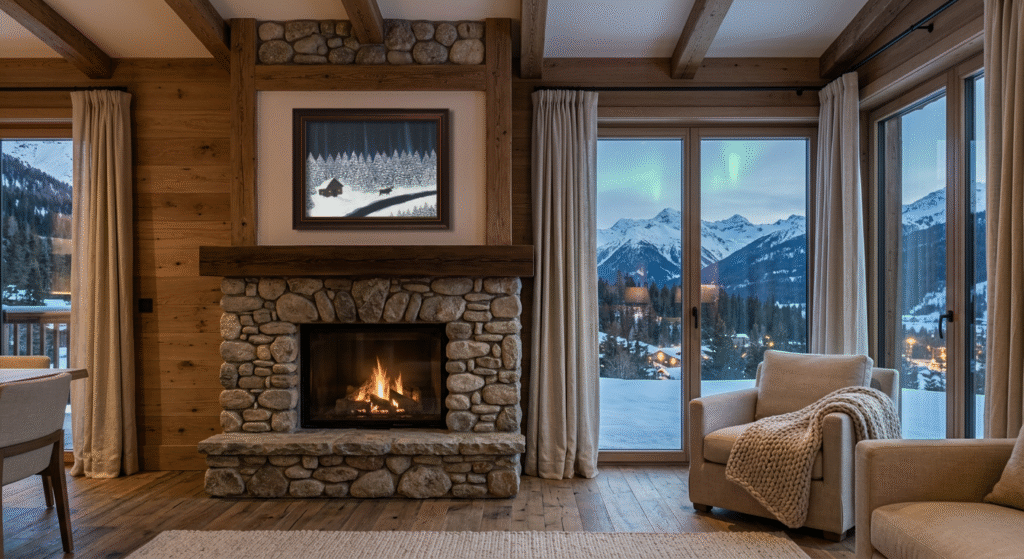
Wildlife and rustic interiors just seem to belong together.
If a room already has natural wood, stone, leather or a view of the outdoors, a wildlife painting doesn’t feel like something added simply to decorate an empty wall. It feels connected to the environment around it.
That doesn’t mean wildlife art is limited to cabins and lodges. I certainly don’t live in a log cabin, and that hasn’t stopped wolves, bears and deer from finding their way onto my canvases.
But there is something about a rustic setting that gives wildlife art a natural home.
Wildlife Has Been Part of Art for a Very Long Time
Animals aren’t exactly a new decorating trend.
Humans have been depicting wildlife in art for thousands of years, from some of the earliest known cave paintings to the work of contemporary wildlife artists today.
The styles have changed dramatically, but apparently we’ve never gotten tired of looking at animals.
I can understand why.
Wildlife gives an artist almost everything you could ask for in a subject: movement, expression, texture, color and personality. Add the surrounding landscape and you have an endless number of possibilities.
That’s probably why I keep coming back to it myself.
The Animal Changes the Entire Painting
Put a snowy forest on a canvas and you have a winter landscape.
Put a wolf in that same forest and suddenly there’s a story.
Where is it going? Is it alone? Did it notice you? What’s beyond the trees?
That’s one of the things I find most interesting about wildlife art. The animal doesn’t necessarily need to be doing anything dramatic to completely change how we experience the scene.
A bear beneath the northern lights creates a different feeling from a deer standing at the edge of a field or a whale moving through dark water.
The landscape establishes the place.
The animal gives it life.
Wildlife Art Works Naturally With Rustic Materials
Rustic homes tend to use materials that already come from the natural world: wood, stone, leather, wool and other organic textures.
Wildlife artwork continues that connection.
A detailed animal painting can become a focal point against wood walls or above a stone fireplace. A landscape containing wildlife can work more quietly within the room. And contemporary wildlife art can provide an interesting contrast in a space with traditional architecture.
You don’t have to match everything.
Actually, I’d prefer that you didn’t.
A room gets much more interesting when it looks like the things inside it were collected because somebody loved them, not because they all appeared together on page 47 of a catalog.
Wildlife Art Can Be Personal
Sometimes we’re drawn to a particular animal for reasons that are difficult to explain.
Maybe you’ve always loved wolves. Maybe you grew up seeing deer behind your house. Maybe you saw a bear during a trip and remember exactly where you were when it happened.
Or maybe an animal simply fascinates you.
That’s enough.
I don’t think you need to assign an official symbolic meaning to every animal you put on your wall. A wolf doesn’t have to represent independence. A bear doesn’t have to represent strength.
Sometimes you just really like bears.
As an artist, I actually think that’s a better starting point.
Original Wildlife Art Has Its Own Personality
One reason I love original artwork in a rustic space is that rustic homes themselves tend to celebrate things with character.
Wood has grain. Stone is irregular. Older furniture shows its age. Handmade objects aren’t perfectly identical.
An original painting fits naturally into that environment because it has those same kinds of variations.
You can see brushstrokes. Colors aren’t perfectly uniform. There are decisions and little imperfections that belong specifically to that piece.
There will only ever be one original.
That’s very different from choosing something simply because you need a picture that’s 24 inches wide to fill a space.
Rustic Wildlife Art Doesn’t Have to Be Brown
I need to defend wildlife art from this one. 😂
Rustic does not mean everything has to be brown, beige and forest green.
Wildlife gives you an excuse to bring some incredible color into a room.
A wolf can stand beneath a blue and purple aurora. A bear can be surrounded by a dramatic sunset. A deer can appear against brilliant autumn foliage. Marine wildlife opens an entirely different palette.
This is one reason I like combining wildlife with dramatic landscapes in my own paintings.
You get the animal and the atmosphere.
Against the natural materials and neutral colors found in many rustic interiors, that color can become the thing that makes the room memorable.
Good Wildlife Art Doesn’t Really Belong to a Trend
Decorating trends change constantly.
Animals don’t particularly care.
Wolves will still be wolves after modern farmhouse is replaced by whatever we’re all apparently supposed to decorate our houses with next.
That’s why I think wildlife artwork has such staying power.
People aren’t necessarily choosing it because it’s fashionable. They’re choosing it because they love the outdoors, have a connection with a particular animal, enjoy the artwork itself, or simply want something interesting to look at.
Those reasons don’t expire when Pinterest announces a new trend.
Choose the Animal That Speaks to You
If you’re choosing wildlife art for a rustic home, cabin or lodge, I’d start with the same question I’d ask when choosing any original artwork:
What do you actually want to look at every day?
Forget the rules for a minute.
If you’ve always loved wolves, start there. If bears remind you of a place you love, look for bears. If you’re happiest near the water, maybe wildlife beneath the surface belongs in your home instead.
Then think about the room, the scale of the painting and the colors around it.
But start with the connection.
Because if you’re going to give an animal a permanent place in your house, you should probably like having him around.
Fortunately, painted bears are considerably easier on the furniture.
Discover More Original Artwork
“Every painting in my collection is inspired by the places, memories, and moments that remind us to slow down, breathe deeply, and reconnect with the natural world.”