

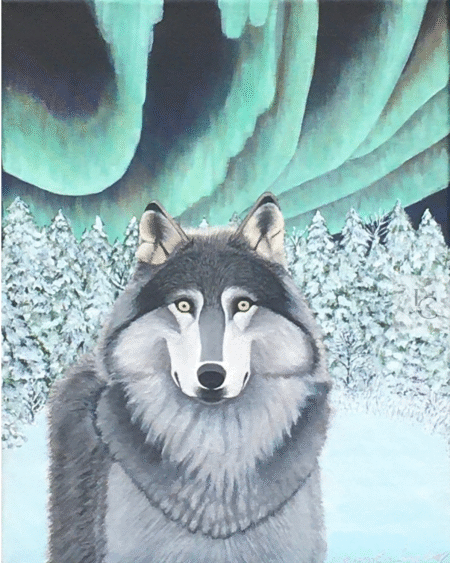
There are some animals you can put into a painting and immediately change the entire mood.
A wolf is one of them.
Put a deer in a snowy forest and you might have a quiet winter scene.
Put a wolf in the same forest and suddenly it feels like there’s a story.
Where is it going?
Is it alone?
Is the rest of the pack nearby?
Has it noticed you?
Wolves have that kind of presence, which is probably one reason they’ve appeared in artwork, stories and folklore for centuries.
They’re also just really interesting animals to paint.
Wolves Are Instantly Recognizable
A wolf doesn’t need much introduction.
The silhouette alone is distinctive—the long legs, heavy coat, pointed ears and tail.
But it’s the face that really gives an artist something to work with.
The eyes can completely change the painting.
Depending on the pose, lighting and expression, the same animal can appear alert, curious, cautious, powerful or completely relaxed.
That’s one of the things I enjoy about wildlife art.
You’re not only painting fur and anatomy.
You’re trying to make the animal feel alive.
They Bring a Story Into a Landscape
Wolves work beautifully in landscape paintings because they naturally create a sense of narrative.
A mountain is a mountain.
A forest is a forest.
But put an animal into that landscape and the viewer starts wondering what’s happening.
A lone wolf traveling through snow creates a completely different story from a pack moving together. A wolf standing in the distance feels different from one looking directly toward the viewer.
The landscape establishes the setting.
The wolf gives you someone to follow through it.
And yes, I’m aware that I’ve just assigned a starring role to the wolf.
I’m okay with that.
Our Relationship With Wolves Is Complicated
Humans have had a complicated relationship with wolves for a very long time.
We’ve admired them, feared them, hunted them, protected them and turned them into characters in countless stories.
Depending on the time, place and culture, wolves have been portrayed in very different ways.
Sometimes they’re dangerous.
Sometimes they’re admired.
Sometimes they’re misunderstood.
And sometimes they’re apparently very concerned about three little pigs and questionable residential construction.
That long history gives wolf imagery a cultural weight that not every wildlife subject carries.
Real Wolves Are More Interesting Than the Stereotype
Popular culture has given us plenty of images of the lone wolf, but real wolves are highly social animals.
They live in family groups and communicate with one another in a variety of ways. Their behavior is much more complex than the simple image of a solitary animal wandering dramatically through the wilderness.
Although, admittedly, the solitary wolf does make a pretty good painting.
Knowing more about the actual animal makes the subject more interesting to me, not less.
There’s always more going on than the stereotype suggests.
Wolves Are Made for Dramatic Landscapes
From a purely visual standpoint, wolves fit beautifully into the kinds of landscapes I enjoy painting.
Snowy forests.
Mountains.
Dark skies.
Open wilderness.
Moonlight.
Their coats also give an artist a surprising amount of color to work with. Gray fur isn’t simply gray. Depending on the animal and the light, there can be warm browns, creams, blacks, silvery tones and subtle color reflected from the surrounding landscape.
Then you have snow, shadows and atmospheric light interacting with all of it.
There’s plenty there to keep a painter busy.
Wolf Art Doesn’t Have to Mean Anything
This may be my favorite point.
Sometimes people attach very specific meanings to animals.
A wolf represents loyalty.
A bear represents strength.
A deer represents gentleness.
And if one of those meanings is personally important to you, that’s wonderful.
But you don’t need a symbolic reason to love wolf artwork.
You can simply think wolves are beautiful.
You can be fascinated by wildlife.
You can love the expression in a particular painting.
You can like the colors.
You can look at it and think, I want that on my wall.
That’s enough.
Art doesn’t always require an explanation.
Wolf Art Can Work in More Than a Cabin
Wolf paintings are an obvious fit for cabins and rustic interiors, especially alongside wood, stone and other natural materials.
But that’s hardly the only place they belong.
A contemporary wildlife painting can work in a modern home. A dramatic wolf portrait can become a focal point in an otherwise simple room. A landscape featuring a wolf may appeal to someone who doesn’t have a single rustic thing in the house.
The subject doesn’t dictate the decorating style.
That’s one reason wildlife art can have such a long life.
The same painting can move from one home to another—or from one room to another—as everything around it changes.
Why Wolves Keep Inspiring Artists
I don’t think there’s one reason wolves have remained such a popular subject.
Part of it is visual. They’re beautiful animals.
Part of it is their behavior and social structure.
Part of it is our long and complicated history with them.
And part of it is simply the effect they have when they appear in an image.
They make us look.
As an artist, that’s enough to keep me interested.
There are still different expressions to capture, different landscapes to place them in, different lighting to experiment with and different stories to tell.
I don’t need a wolf to symbolize resilience, independence or anything else before I decide it’s worth painting.
Sometimes I just want to paint the wolf.
Discover More Original Artwork
“Every painting in my collection is inspired by the places, memories, and moments that remind us to slow down, breathe deeply, and reconnect with the natural world.”