

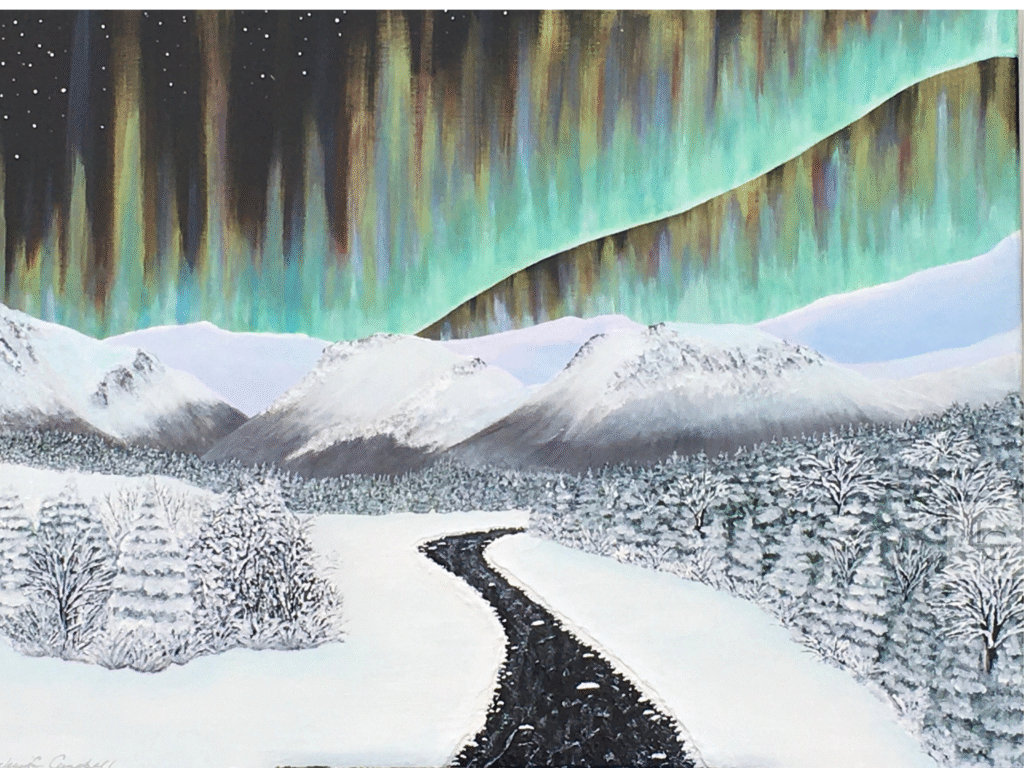
I’ve painted the northern lights more times than I can count, and somehow I’m still not tired of them.
That’s probably because there’s no single way to paint an aurora.
The colors change. The shapes change. The landscape underneath changes. One painting can be filled with brilliant greens and blues while another leans into purple, turquoise or pink. Put those colors over mountains, water, snow or a dark forest and you have an entirely different scene.
For someone who loves color and dramatic landscapes, it’s difficult to ask for a better subject.
No Two Auroras Are Exactly Alike
One of the things I love about painting nature is that it doesn’t follow a template.
The northern lights take that to another level.
An aurora can appear as a soft glow along the horizon, long ribbons stretching across the sky or enormous curtains of light overhead. The colors and intensity can change from one display to another.
That gives me a lot of freedom as an artist.
I can paint the northern lights repeatedly without feeling like I’m painting the same picture over and over again.
Apparently I’ve decided to test this theory extensively.
Painting Light Is Completely Different From Painting an Object
If I’m painting a tree, I have an object to work with.
There’s a trunk. There are branches. There are recognizable shapes.
Light is different.
You can’t really paint light. You’re painting color, contrast and the effect that light has on everything around it.
That’s what makes an aurora challenging.
The brightest parts need to appear luminous against a dark sky. Colors have to transition without becoming muddy. The shape needs enough movement to keep it from looking like a stripe painted across the canvas.
Then the landscape underneath has to belong in the same world.
That’s where the fun starts.
The Darkness Is Just as Important as the Color
You can’t have a glowing aurora without darkness around it.
I think that’s one of the reasons northern-lights paintings can be so dramatic. You’re working with extremes.
Deep blues, dark forests, silhouetted mountains or shadowed snow create the backdrop. Then suddenly you get these incredibly bright colors moving through the sky.
The dark areas aren’t empty space.
They’re what allow the light to work.
As a painter, I love that contrast.
Reflections Give Me Even More to Play With
Put an aurora over water and things get really interesting.
Now I’m not only figuring out what’s happening in the sky. I’m figuring out how that light interacts with the surface below it.
Still water might create a recognizable reflection. Moving water breaks those colors apart. Snow and ice can pick up pieces of the color without reflecting the sky literally.
It gives me another opportunity to carry the light through the painting instead of leaving all the excitement at the top of the canvas.
And I apparently have no objection to making more work for myself.
Sometimes I Let the Paint Catch the Light Too
One detail I sometimes incorporate into my northern-lights paintings is a subtle shimmer in parts of the paint.
I don’t want it to overpower the painting or turn the entire thing into glitter.
The effect is much quieter than that.
When the light catches it from certain angles, there’s a slight change in the surface. I like that because an actual aurora isn’t static. It changes as you watch it.
Obviously, I can’t make a painting move across the sky.
I’m good, but I’m not that good.
So a subtle shift in how the surface catches light gives the painting a little something that isn’t always visible from every angle.
Color Is Probably the Biggest Reason I Keep Coming Back
I love color.
Northern lights give me an excuse to use a lot of it.
Blue against purple. Green fading into turquoise. Pink appearing unexpectedly against a dark sky. Warm light from a cabin against cool colors outside.
There are so many combinations to explore that I don’t feel restricted to one recognizable “northern lights palette.”
And that’s important to me.
I’m interested in realism, but I’m also interested in creating a painting with atmosphere and impact. I don’t want every landscape to simply document what something looked like.
I want it to be worth looking at.
The Landscape Underneath Changes the Story
An aurora by itself is beautiful, but what happens underneath it can completely change the painting.
Mountains make the sky feel enormous.
Trees can create depth and scale.
Water gives you reflections.
Snow catches color.
Architecture introduces a human element into an otherwise wild landscape.
That’s one of the reasons I don’t think I’ll run out of northern-lights ideas anytime soon.
The sky may be the star, but the landscape gives it somewhere to perform.
There’s Still Something Extraordinary About Them
We understand what causes the aurora.
Charged particles from the sun interact with Earth’s magnetic field and atmosphere, producing the light we see in the sky.
Knowing the science doesn’t make it any less incredible.
If anything, I think it’s even stranger that this is an actual thing our planet does.
You can walk outside on the right night and see the sky glowing green.
That’s ridiculous.
And wonderful.
Why I Keep Painting the Northern Lights
Eventually, every artist finds certain subjects they keep returning to.
The northern lights are one of mine.
They give me color, contrast, movement, landscapes, reflections, technical challenges and almost endless possibilities for creating something different.
But there’s also a simpler explanation.
I just think they’re beautiful.
Sometimes artists don’t need a more complicated reason than that.
And until I get tired of finding new ways to put glowing colors across a dark sky, I’ll probably keep painting them.
Judging by the number I’ve already painted, that may take a while.
Discover More Original Artwork
“Every painting in my collection is inspired by the places, memories, and moments that remind us to slow down, breathe deeply, and reconnect with the natural world.”