

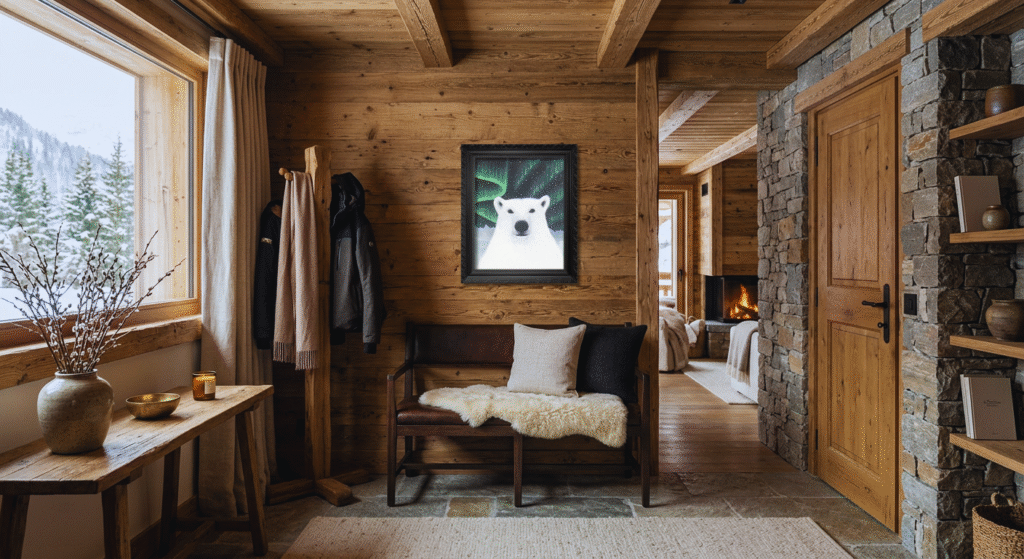
Wildlife paintings and cabins are a pretty natural combination.
Wood walls, stone fireplaces and views of the outdoors already create a strong setting for wildlife art. The challenge usually isn’t figuring out whether the two belong together.
It’s figuring out how much is enough.
Because there’s a difference between decorating with wildlife artwork and making visitors wonder whether they’ve accidentally entered a very comfortable natural-history museum.
The good news is that wildlife art can work with almost any version of cabin style—from traditional and rustic to surprisingly modern.
Start With One Painting You Really Love
If you’re decorating from scratch, I wouldn’t begin by deciding that you need a bear painting, two deer paintings and something with a moose because that’s what cabins are supposed to have.
Start with the artwork you actually love.
One strong wildlife painting can establish the personality of an entire room.
Once that’s in place, you can make other decisions around it rather than trying to fill every available wall with something appropriately outdoorsy.
This is especially important with original artwork.
Give it enough room to matter.
Consider the Animal, But Don’t Get Too Literal
It can be fun to choose wildlife found around your cabin.
Here in New England, that might include moose, black bears, deer, foxes, loons and other animals familiar to the region.
That can create a wonderful connection between the artwork and the location.
But it’s not a requirement.
If you love wolves, hang a wolf.
If you love an animal you’ve seen while traveling somewhere else, that’s meaningful too.
Your cabin walls are not required to represent an accurate census of the local wildlife population.
Use Scale to Your Advantage
Wildlife art can have a lot of visual presence, so size matters.
A larger painting can work beautifully above a sofa, on a substantial wall or near a fireplace where it has enough space around it.
Smaller wildlife paintings can be used in bedrooms, hallways, reading areas and other places where people will naturally see them from closer distances.
Think about the animal within the composition too.
A close-up portrait of an animal can feel much more visually powerful than the same animal appearing in the distance within a landscape.
Two paintings of exactly the same dimensions can therefore have completely different effects in a room.
Let the Painting Introduce Color
Wildlife artwork doesn’t have to mean brown.
That’s particularly useful in cabins, where wood can already provide plenty of warm neutral color.
A wildlife painting might introduce snowy blues, forest greens, sunset oranges, deep nighttime colors or even the brighter colors of an aurora.
Those colors can provide contrast against wood walls and rustic furnishings rather than disappearing into them.
You can then repeat one or two colors from the painting elsewhere in the room if you want to tie things together.
Just don’t feel obligated to match everything.
The moose does not care whether he coordinates with the sofa.
Mix Wildlife With Landscapes
If you want several pieces of nature-inspired artwork in the same room, they don’t all need to feature animals.
In fact, mixing wildlife paintings with landscapes can create a more interesting collection.
A wildlife painting might be the focal point, while smaller landscapes appear elsewhere in the room.
You can also vary the perspective. A detailed animal portrait next to another detailed animal portrait can start to feel repetitive, while pairing one with an expansive landscape gives the eye something different to explore.
Think of the artwork as a collection rather than a matching set.
You Don’t Need the Animal Everywhere Else
This is where restraint becomes your friend.
If you have a beautiful bear painting, you probably don’t also need bear pillows, bear lamps, bear figurines, a bear rug and a wooden sign explaining that bears live here.
Let the painting be the bear.
The rest of the room can include natural materials, interesting furniture, books, family photographs, pottery, blankets and other things that have nothing whatsoever to do with wildlife.
That actually gives the artwork more impact because it isn’t competing with twenty-seven smaller versions of the same idea.
Wildlife Art Doesn’t Have to Look Traditional
Cabin decorating has changed.
Wildlife artwork doesn’t have to be dark, brown or heavily traditional to work in a rustic setting.
Colorful or contemporary paintings can create a great contrast with old wood, stone and vintage furnishings.
That combination can keep a cabin from feeling dated while still respecting its rustic character.
You also don’t need matching frames throughout the entire house.
Choose frames that suit the individual artwork and work reasonably well with the room.
“Reasonably well” is an underrated decorating standard.
Think About Where You’re Viewing the Painting From
Placement isn’t only about finding an empty wall.
Think about where people will actually see the painting.
A large piece across from the main seating area can become something you notice every time you sit down. A smaller detailed painting may be better somewhere people naturally walk close to it.
Also consider sightlines between rooms.
Sometimes artwork placed at the end of a hallway or visible through a doorway has more impact than something hung on the largest wall.
And if there’s already an incredible view outside a window, you don’t necessarily need artwork competing with it.
Let both have their moment.
Build the Collection Over Time
A cabin doesn’t have to be completely decorated the weekend you get the keys.
Actually, I think spaces become more interesting when they’re allowed to develop over time.
You might find a painting while traveling. Commission something connected to a particular memory. Discover an artist whose work you love. Add another piece years later.
Eventually, the artwork becomes part of the history of the cabin.
That’s much more personal than ordering an entire coordinated “rustic wildlife collection” in one afternoon.
Make It Your Cabin
There are plenty of decorating guidelines, but cabins are supposed to have personality.
If you want one dramatic wildlife painting and otherwise minimal decor, do that.
If you love collecting wildlife art and want several pieces throughout the cabin, that can work too.
Pay attention to scale. Give important pieces some breathing room. Mix subjects and perspectives. Use color. Avoid repeating the same theme so many times that individual paintings disappear into it.
Most importantly, buy artwork because you actually love it.
Your cabin doesn’t need to look like everybody else’s idea of a cabin.
It needs to look like yours.
Discover More Original Artwork
“Every painting in my collection is inspired by the places, memories, and moments that remind us to slow down, breathe deeply, and reconnect with the natural world.”