

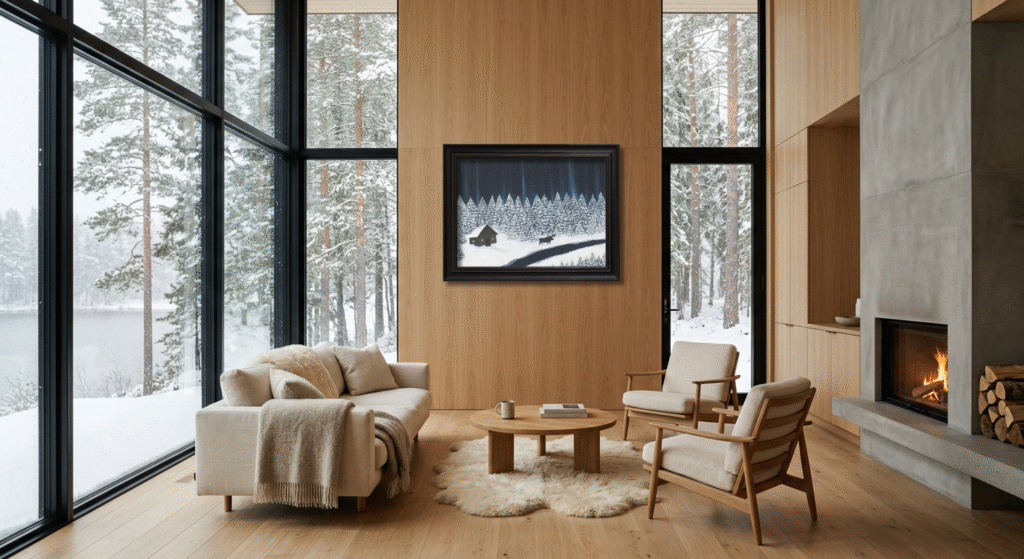
A peaceful home doesn’t have to be beige.
I feel like we should establish that immediately.
Somewhere along the way, “calming decor” became associated with rooms where everything is cream, nothing appears to have ever been used, and you’re slightly afraid to put down a coffee cup.
That’s one version.
But I think a peaceful home has much more to do with creating a space that feels comfortable to you.
And nature-inspired artwork can be a wonderful part of that.
Choose Art You Actually Enjoy Looking At
This sounds obvious, but it’s easy to forget when decorating.
Don’t choose a painting because someone told you blue is relaxing or forests are peaceful.
Choose it because you like looking at it.
Maybe you’re drawn to the ocean.
Maybe you love mountains, wildlife, snowy forests or dramatic skies.
Maybe your idea of peaceful is a quiet lake.
Maybe it’s a thunderstorm.
The emotional connection you have with the subject matters more than whether it appears on somebody’s list of officially relaxing things.
Give the Artwork Some Breathing Room
You don’t need to fill every inch of every wall.
In fact, leaving some open space around artwork can make the entire room feel less visually crowded.
If you have one painting you really love, let it have some presence.
This is particularly important with larger original artwork. A strong landscape or wildlife painting doesn’t necessarily need a collection of signs, shelves and decorative objects surrounding it.
Sometimes the painting is enough.
Your walls are allowed to have days off.
Use Nature Art to Introduce Color
Nature gives you an enormous palette to work with.
Forest greens and ocean blues are obvious choices, but there are also autumn oranges, sunset reds, snowy whites, stormy grays, wildflowers, turquoise water and colorful night skies.
That means nature-inspired artwork can bring color into a room without requiring everything else to be colorful.
If your furniture and walls are fairly neutral, a painting can become the place where the room comes alive.
And if your house is already colorful?
Good.
Nature isn’t beige either.
Think About Scale
The size of artwork affects how a room feels.
One substantial painting can create a clear focal point on a large wall, while a collection of smaller pieces creates more visual activity.
Neither approach is wrong.
It depends on what you want from the space.
If you’re trying to make a room feel visually simpler, one larger piece may work better than many small objects competing for attention.
For smaller areas, a single small original can create a moment of interest without overwhelming the space.
The goal isn’t to make the artwork disappear.
It’s to give your eye somewhere enjoyable to land.
Consider What Else Is Competing for Attention
Sometimes the problem isn’t the artwork.
It’s everything around it.
A beautiful painting can get lost when it’s surrounded by too many unrelated objects.
Look at the entire wall.
If you already have artwork, photographs, shelves, signs, a television and seventeen decorative objects competing for attention, adding another painting probably isn’t going to create tranquility.
It might be time to edit instead.
I know. Nobody likes that answer.
But sometimes decorating means taking something away.
Use Artwork to Balance the Room
Artwork can also help visually balance furniture and architectural features.
A painting over a sofa can give weight to a large blank wall. Artwork beside a fireplace can balance another feature on the opposite side of the room. A smaller painting can give purpose to an awkward wall that otherwise feels forgotten.
Before hanging something, step back and look at the room as a whole.
Where does your eye naturally go?
Where does something feel missing?
And where is there already plenty happening?
Those questions are often more useful than following a decorating formula.
Let Personal Memories Into the Room
One of the things I find most interesting about nature artwork is how differently people respond to the same scene.
One person sees a lake.
Someone else sees summers at their grandparents’ camp.
One person sees a snowy road.
Someone else remembers growing up somewhere that looked exactly like it.
That’s when artwork becomes more than part of the color scheme.
It becomes personal.
If a painting reminds you of somewhere you love, an experience you’ve had or something you want to see someday, that connection is going to last much longer than a decorating trend.
Peaceful Doesn’t Mean Empty
I’m not interested in homes that look as though nobody actually lives there.
Books are going to get left out.
Blankets move.
Kids have belongings.
Pets have absolutely no respect for interior design.
A peaceful home can still have personality, color and evidence of human life.
The goal isn’t to remove everything until your living room resembles a waiting room.
It’s to be intentional about what you bring into it.
Keep the things you love.
Give them enough room to be appreciated.
And don’t worry quite so much about whether everything matches.
Create Your Version of Peaceful
There isn’t one correct way to create a peaceful home.
For some people, that means light colors and quiet landscapes.
For someone else, it might mean rich wood, dramatic artwork and a fireplace.
Your home should reflect your version.
Nature-inspired artwork works particularly well because nature gives us so many different moods to choose from—quiet and dramatic, colorful and subdued, familiar and completely wild.
Choose the version that speaks to you.
Then give it a good place to live.
Because a peaceful home doesn’t need to look like anybody else’s.
It just needs to feel like yours.
Discover More Original Artwork
“Every painting in my collection is inspired by the places, memories, and moments that remind us to slow down, breathe deeply, and reconnect with the natural world.”